
An army can lose a battle and return another year. For the people defending their homes, winning the day does not settle what happens next. That is the question behind this film: how could Baltic communities defeat crusading armies and still face the loss of their land?
Its title challenges a familiar stereotype. Calling a society primitive tells us little about how its people lived or made decisions. Nor should their dignity depend on how many battles they won. Here, the military record helps expose the weakness of a story in which conquest was easy and resistance barely mattered.
The focus is on Baltic peoples, especially Samogitians and Semigallians. That does not mean every people living in today’s three Baltic states. Semigallian lands extended across parts of present-day Latvia and northern Lithuania, and their society had its own centres of power. [1]
Victories separated by a generation
On 22 September 1236, the Livonian Brothers of the Sword suffered a devastating defeat at Saule. Lithuanian institutional accounts identify Samogitian forces with the victory. The order’s master was killed, and the disaster helped bring about the surviving brotherhood’s incorporation into the Teutonic Order in 1237. [2] [3] [6]
This was a serious reversal for a military organisation that had also become a territorial power. Yet its defeat did not remove the wider structures supporting conquest. Incorporation gave the survivors a place within another order. The aftermath itself shows why a battlefield victory and an end to the war were different outcomes. [3]
The precise location of Saule remains disputed. Historian Guntis Zemītis has discussed competing interpretations of the sparse evidence. The film’s difficult ground and individual clashes make the encounter imaginable; they cannot tell us exactly where each fighter stood. [4]
Fifty-one years later, on 26 March 1287, Semigallians defeated crusader forces at Garoza. The Livonian master died in that battle. These were separate victories, fought by different forces decades apart. A child born after Saule could already have grown old by Garoza. [1] [5]
What winning could not secure
Around 1290, some Semigallians left for Lithuania under continuing military pressure. The departure is attested, but the reported numbers require caution. It did not mean that every Semigallian disappeared or that struggles over the region ended at once; resistance continued into the following century. [1]
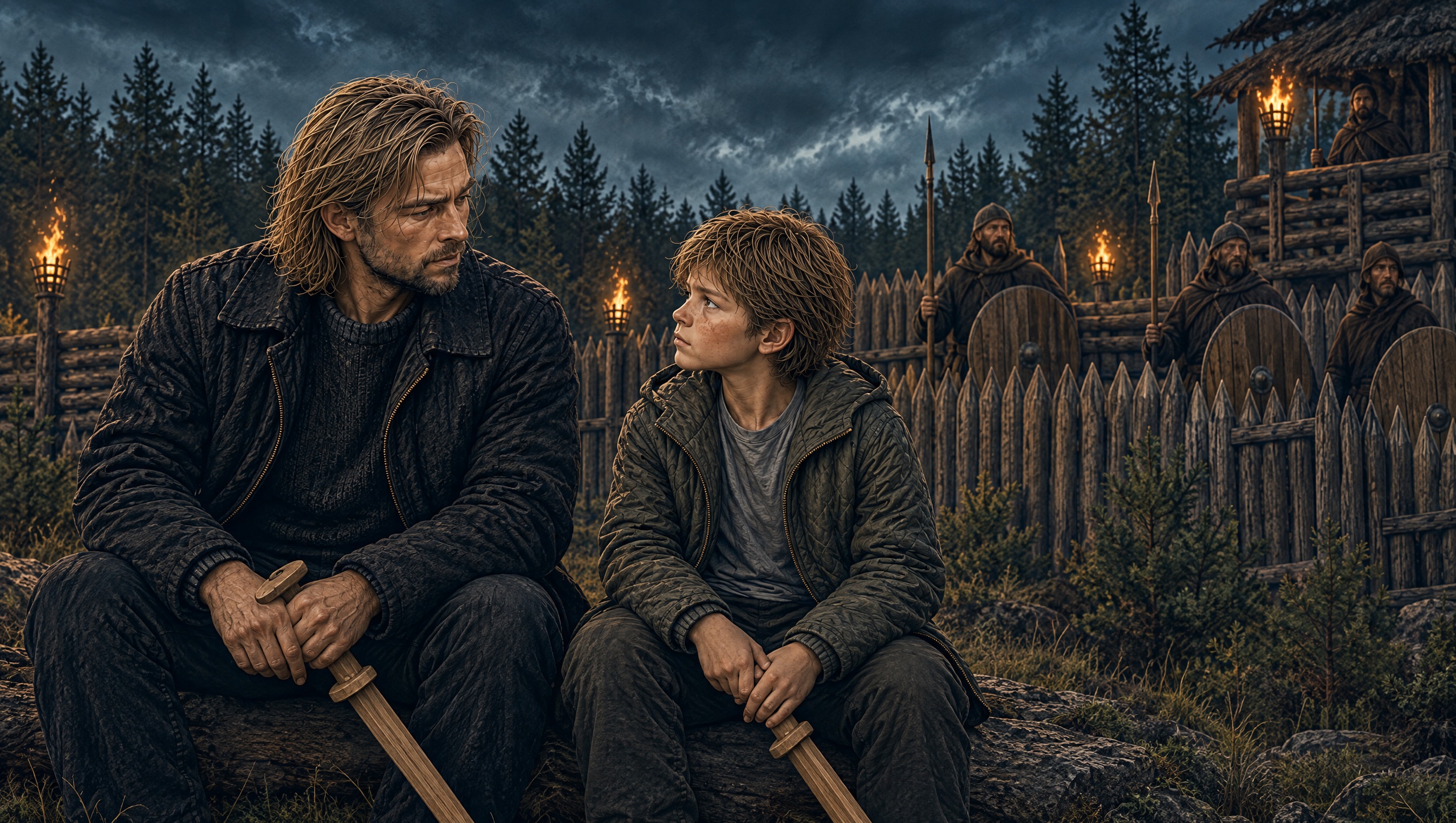
The film brings that distance between victory and security back to a child’s question. Its departing family and wooden toy sword are invented, giving the consequences a human scale without claiming to show an identified family.
The battles deserve to be remembered. So does the question that remains when the weapons are lowered: could people keep living in the place they called home?
THE STORY IN MOTION
Watch the story
See the scene brought to life in The Baltic Code’s short film.
Press play to load the YouTube player. Watch on YouTube ↗
Sources & historical notes 6 references
- Guntis Zemītis, Zemgaļi. Nacionālā enciklopēdija. ↗
Scholarly synthesis of Semigallian territory, political organisation, Garoza and migration around 1290. Reported migrant numbers are treated cautiously; resistance continued into the fourteenth century.
Back to the story ↑ - Ministry of National Defence of Lithuania, The Major Battles and Military Operations of the Lithuanian Armed Forces (2019), PDF page 2, entry 1. ↗
Institutional summary dating Saule to 22 September 1236. It labels the victors broadly as Lithuanians and does not establish detailed battlefield choreography.
Back to the story ↑ - Ilgvars Misāns, Zobenbrāļu ordenis. Nacionālā enciklopēdija. ↗
The Sword Brothers’ defeat in 1236, political and territorial role, and incorporation into the Teutonic Order in 1237.
Back to the story ↑ - Guntis Zemītis interviewed by LTV’s 4. studija, 26 September 2021. Published by LSM. ↗
The historian discusses conflicting evidence for Saule’s location. Terrain and combat scenes in the film remain interpretations, not a verified reconstruction.
Back to the story ↑ - Guntis Zemītis, Salgales pagasts, historical section. Nacionālā enciklopēdija. ↗
Dates the battle near Garoza to 26 March 1287 and identifies the Semigallian victory over the master’s crusader forces.
Back to the story ↑ - Lithuanian Armed Forces, Žemaitija Brigade: Istorija, historical origins section. ↗
Used narrowly for the Samogitian role at Saule. The page’s broader celebratory claims, numerical comparisons and other battle dates are not adopted here.
Back to the story ↑
About the reconstruction
Witness and the Young One are fictional modern guides. The wooden-sword game, fort, individual fighters, horse, departing family and historical child are illustrative reconstructions. Neither the dialogue nor the combat is documented personal testimony. Saule and Garoza are separate events, fifty-one years apart.